December 1, 2025
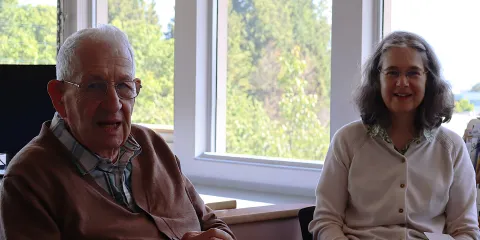
Tommy Jellinek, graduate of one of SCARP’s earliest cohorts back in 1963, returned to Vancouver this Spring to celebrate his granddaughter’s graduation from University.
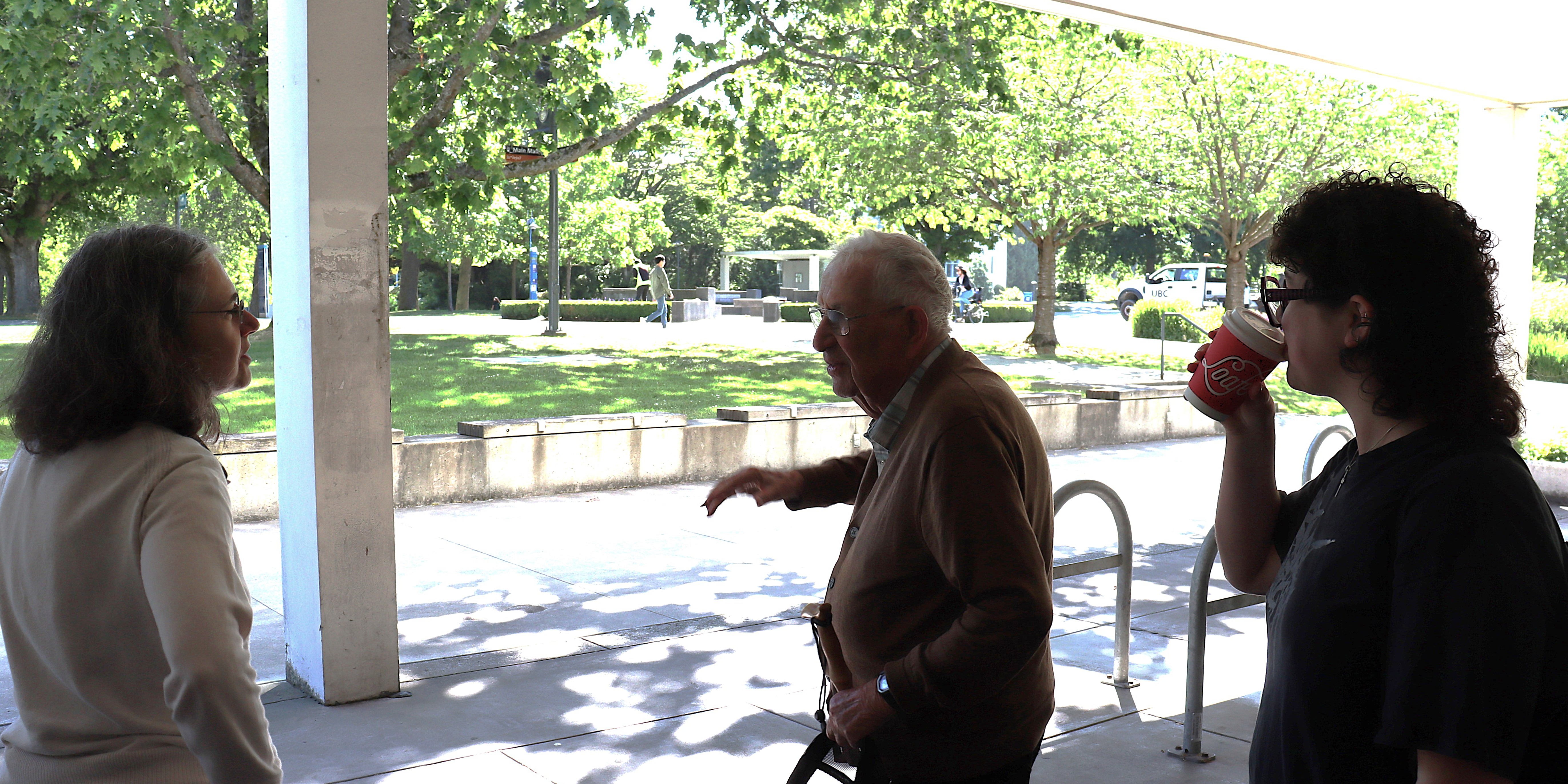
Feeling nostalgic for his time at SCARP, this alum from SCARP’s first decade came to our School for a visit and met SCARP's modern-day Director Heather Campbell. Together, we reflected on why Planning is important, how Vancouver and the world has grown, and how far we’ve come at UBC’s School of Community and Regional Planning.
SCARP 75
SCARP is on the cusp of its 75th anniversary as a School. To celebrate, we’ll be showcasing how it all started and what we’ve built together since. We’ll celebrate the community of grads, planners, and partners now networked worldwide addressing some of today’s greatest challenges, as well as the extraordinary research our current faculty and students have underway to transform the world and revolutionise the field of Planning.
A visit from Tommy Jellinek has been the perfect way to begin.
Tommy’s story
Hubbub about a new Planning School
Tommy came to Canada in order to go to university. That started with an undergrad in Botany at McGill. (Planning has always been a strongly transdisciplinary field, each lens contributing a vital perspective on how to build and live together.)
Working as an Intern for his Dean, he was asked whether he’d considered being a Town Planner. Sure enough, soon his wife drove him to Vancouver where he met “the famed Dr. Oberlander”.
“Oberlander was an interesting cat!”
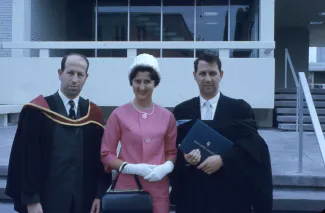
As Tommy explained, “Most schools would tell you, ‘Look to your left, look to your right; only one of you will graduate!' But Peter Oberlander said, ‘You will all graduate, or you won’t be here.’ He was an incredible lecturer and an altogether incredible person.”
Tommy elaborated that Oberlander began BC’s new Planning School holding its students to a high standard to prepare them for the world’s busy era of hyper-urbanization: he reportedly said to the students in these early days, “You’re going to be professionals” and “You’ll have 3 jobs in 10 years”.
Extraordinary diversity – “We were a mixed bag!”
Tommy was one of 11 students in the 3rd cohort of the young School, and he fondly remembered them all. They hailed from Guinea, Saskatchewan, Quebec, India, and elsewhere, each with impressively different contexts and expertise. The diverse perspectives they brought were a transformative experience for everyone.
While Director Oberlander provided a great deal of the teaching and projects, invited renowned architects and other professionals from Greater Vancouver, the United Kingdom, etc. also gave instruction to the students.
UBC and SCARP pushed students to grow and to grow together, much as it does today. Tommy explained UBC at the time required students to be able to read a simple paper in a foreign language. SCARP in particular would bring students together through their work: “Most of us had never worked collectively. That was not the way [other] universities ran. We had to get used to the idea, and Oberlander would assign projects and people to do them, to get us going.”
Tommy’s Vancouver
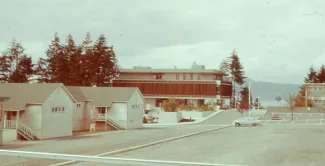
In Tommy’s time, Canadian cities like Vancouver were undergoing rapid change, and Tommy believed that required not just adherence to regulations but positive plans. As Tommy put it in his SCARP thesis,
“As a result of changing conditions in Canada since the Second World War, suburban municipalities… have found themselves coping with the problems of rapid urbanization. The suburban municipalities seem to have failed in meeting these problems, partly as the result of not having a positive land use policy.”
A life of achievement and community after SCARP
Most of Tommy’s 1963 cohort went on to do extraordinary things, including several Deputy Ministers in governments across Canada and a PhD at Harvard.
After graduating, Tommy himself explored job prospects across Canada, answering interviews and job offers. His story of that time is a true travelogue of contemporary Canada, such as when he arrived in a town near Edmonton for a job during a rodeo and he and his wife watched Chuck Wagons outside his hotel window. Living in the small town felt idyllic, but eventually Tommy realised it would be “too easy” to stay in this job indefinitely, and he understood new meaning in Director Oberlander’s prediction, “You’ll have 3 jobs in 10 years”. Sure enough, his next job was in St. John’s, Newfoundland.
Later, after coming to Nova Scotia for a conference and then visiting a colleague at UNB, he decided to visit the Fredericton local government building while in town. When he identified himself as a Planner there, the city’s interim Planning Director took him by the arm, brought him to the Deputy Minister offices, and happily announced to the room, “We got one!”
“So we went out and we started planning! That was it, I put in my 25 years.” He served as Director there, starting with a joint effort to rewrite Nova Scotia’s Planning Act.
"My next project was an interesting one: I asked myself, 'Would I have listened to the Planners if I was on the other side of the coin?' So I ran for City Council!" He served on council for years, and ultimately, the answer to this question came: while you “had to be practical” in everyday matters, “On matters of serious policy, yes, you listen to the Planners.”
Why Planning is important
Tommy describes that to be a Planner is to keep leaders and community alike informed about what each decision means: what each choice makes happen and how it affects the way people live.
“The decisions you make affect an awful lot of people.” At the governmental level, “If the fed comes down about some social economic program, the first question is, ‘Do you have a plan.’” Even at the individual level, with housing for instance, houses aren’t just assets: one’s “entire culture revolves around the house.”
From Tommy’s perspective, Canada at this time is a story of how Planners helped modern-day Vancouver and Canada become itself, and how Planning at its best centers the human element.
“To me, what Planning is really all about is presenting to the public the various outcome of their decisions… To me, the important thing is that people make choices in full knowledge of what they’re going to conserve.”
As the world of Planning tackles the 21st century, there are even more questions to ask and the stakes are as high as ever, but the principle of why Planning exists remains the same. As Tommy, puts it:
“Planning affects everything. There’s only one Earth; you can play around with it, but…”
SCARP today
Today, SCARP’s mission is to generate and transform knowledge into action by planning in partnership, to improve lives and communities and the quality of built and natural environments. We believe Planning is concerned with the well-being of communities, whether rural, metropolitan, or worldwide, and to facilitate equitable change to help people.
Tommy was pleased and impressed with how his Alma Mader has developed, how diverse our faculty have become, and that we prioritise an overall approach that doesn’t silo the many questions Planning represents. He also spoke of the importance of cross-training between fields such as Planning and Civil Engineering, so the many fields concerned with the built environment and communities have a comprehensive understanding of each other’s insights and lenses.
UBC’s Planning School today takes on today’s biggest challenges through many academic lenses and listening to and partnering with impacted communities.
As Director Campbell says,
“It is the way of Planners that we believe a better future can always be created. We are concerned with action and change, and the partnerships that make change work for all populations… This journey begins with curiosity as well as the relaying of knowledge between generations of Planners, with the understanding that each new generation will surpass the last, discovering something new, creating a transformational framework, or forge a renewed partnership with a community for a more equitable way forward.”
Looking to the future
Today, SCARP has graduated about 3,000 practicing planners into the field and counting.
Since our beginnings 75 years ago, major cultural, technological, economic, and social changes have taken place locally and globally. In response, SCARP alumni have contributed to the practice of linking knowledge and action in a changing world, and across a broad array of tomorrow's most daunting - and daring - questions.
The new faculty who have joined us have bold research questions and initiatives to unravel tomorrow's questions.
We're proud of the story that amazing alumni like Tommy represent, and boldly carry on the pursuit of knowledge in action and planning in partnership.