October 10, 2025
We're proud to celebrate a recent report on Metro Vancouver's disaster preparedness co-authored by SCARP Associate Professors Mike Hooper and Theo Lim, and involving an entire class of SCARP's MCRP students.
This report represented a collaboration between researchers from UBC's Disaster Resilience Research Network (DRRN) and the City of Vancouver Emergency Management Agency (VEMA).
Understanding Disaster Preparedness in Vancouver: Community Perspectives
This report examines how Vancouverites view and undertake disaster preparedness activities. The study surveyed nearly 3,000 residents and held six focus groups to better understand how people perceive risk and prepare for disasters.
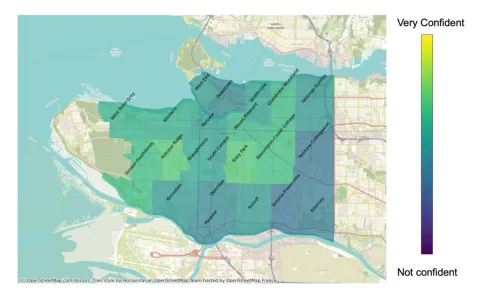
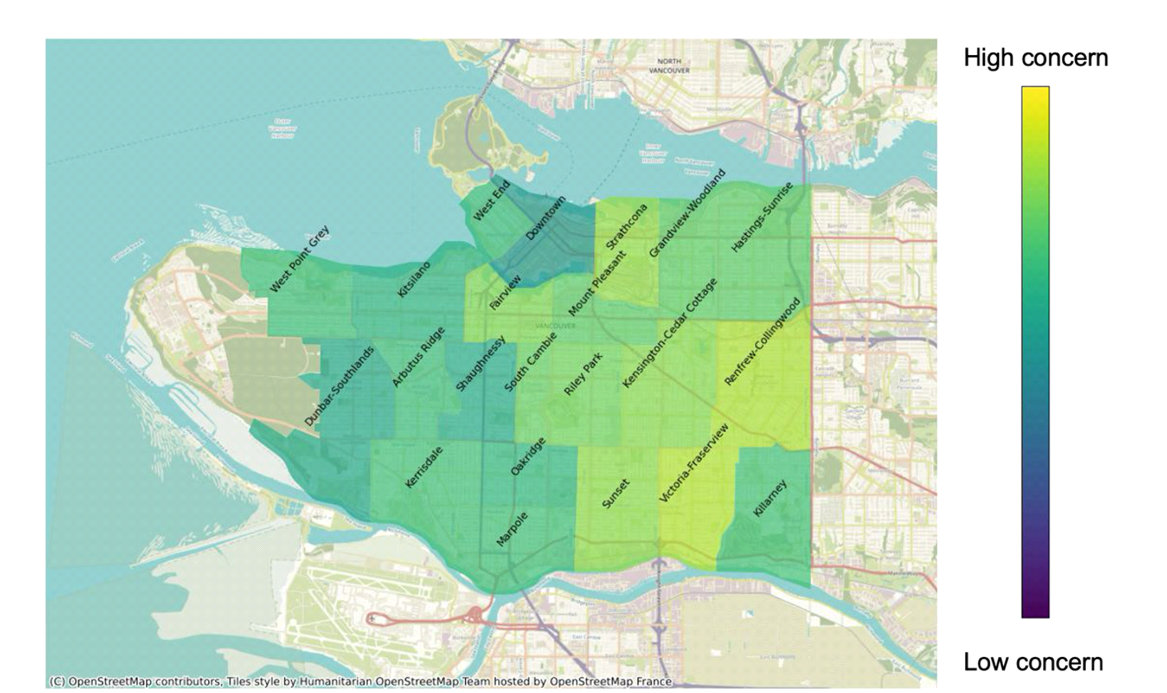
Key findings indicate that, generally, earthquakes and wildfire smoke were the hazards of greatest concern, though many participants expressed concern about a broad range of risks. Notably, risk perception and preparedness behaviours were highly localized: in other words, different neighbourhoods and socioeconomic groups had noticeably different perceptions regarding how much of a problem each potential disaster represented. The figure below shows neighbourhood-specific reflections on one of many disaster scenarios, extreme heat events.
"Insights about the factors at play emerged from focus group discussions, revealing "a nuanced distinction between belief in government’s technical knowledge versus confidence in its actual emergency preparedness and response capacity. A perceived failure to address persistent issues such as affordability and housing eroded public trust in government-led preparedness efforts." (Eaton J et al, Page 2)
Figure from study: Level of concern for extreme heat by (Vancouver) neighbourhood
These research findings will support the City of Vancouver to address barriers to emergency preparedness.
Dr. Hooper affirmed the report represented "an exciting and productive collaboration between UBC researchers and the City of Vancouver".
As Dr. Lim remarked,
"This demonstrates community engaged learning and real-world impact of a Planning education."
Deeply congruent with what SCARP teaches, these findings show that disaster planning works best when tailored to populations and regions at the neighbourhood level, and grounded in residents’ lived experience. In addition:
"These early reflections, based on preliminary analysis of the focus group discussions conducted in this study, point to the importance of embedding trust-building measures within disaster preparedness strategies, particularly by addressing the social determinants that shape public confidence in emergency institutions." (Eaton J et al, Page 16)
The City of Vancouver is using UBC DRRN's findings to inform its public education strategy on emergency preparedness.
SCARP's students get involved as part of their class project
An entire class of SCARP's Master of Community and Regional Planning students were involved in producing the report, as part of their final project in PLAN 506.
The PLAN 506 students were given the survey responses, and were tasked with the crucial breakdown by neighbourhood and in-depth profiles of each neighbourhood. Thanks to the students, each neighbourhood has a personalised profile of risks, concerns, and barriers, enabling the personalised planning that takes into account various populations and, in a disaster, strives to ensure no profile of citizen is left behind.
PLAN 506 students' Vancouver Neighbourhood Preparedness Summaries
A thriving research collaborative at UBC SCARP
UBC's School of Community and Regional Planning is a leader in both education and research. Whether hired as Graduate Academic Assistants or participating in a partnership for part of a course, there are exciting opportunities to be a part of UBC SCARP's good works and to expand your portfolio and network.
This demonstrates community engaged learning and real-world impact of a Planning education.
Some more student research projects
More about Associate Professor Mike Hooper
Michael Hooper's research focuses on urban planning, policy and politics, with particular interest in three themes related to urban spatial transformation: displacement, disasters and densification. Across these topics he has a strong cross-cutting interest in public participation, governance and organizations.

More about Associate Professor Theo Lim
Dr. Lim's research purpose is to ensure knowledge is used to create healthy, just, and inclusive futures for the most marginalized in society; mainly emphasising how data and models are used in environmental policy and planning contexts, and how to engage with community around urban climate adaptation to achieve just outcomes.